

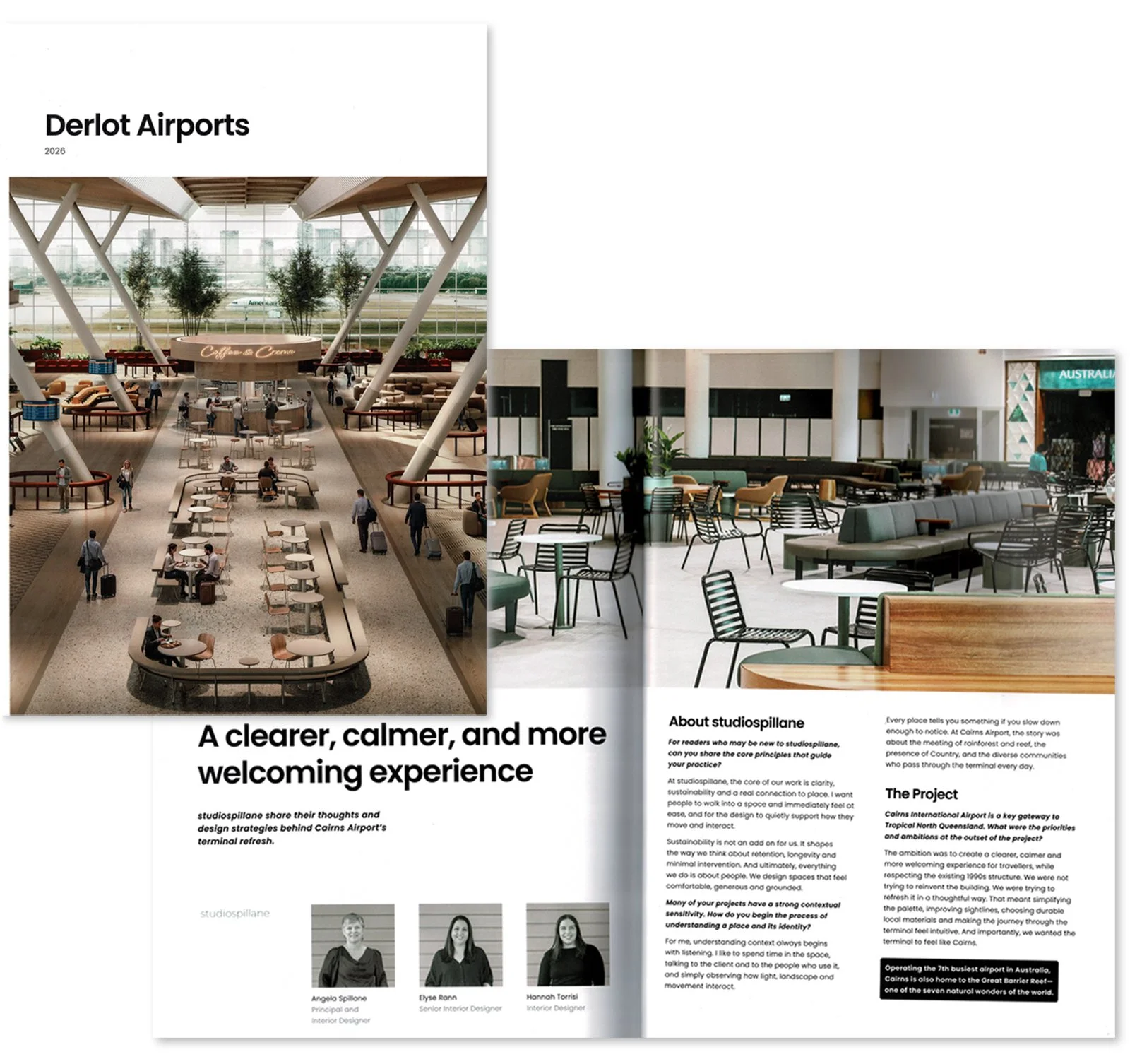
‘A clearer, calmer and more welcoming experience’
Derlot Airports | 2026 issue
studiospillane share their thoughts and design strategies behind Cairns Airport’s terminal refresh.
About studiospillane
For readers who may be new to studiospillane, can you share the core principles that guide your practice?
At studiospillane, the core of our work is clarity, sustainability and a real connection to place. I want people to walk into a space and immediately feel at ease, and for the design to quietly support how they move and interact.
Sustainability is not an add on for us. It shapes the way we think about retention, longevity and minimal intervention. And ultimately, everything we do is about people. We design spaces that feel comfortable, generous and grounded.
Many of your projects have a strong contextual sensitivity. How do you begin the process of understanding a place and its identity?
For me, understanding context always begins with listening. I like to spend time in the space, talking to the client and to the people who use it, and simply observing how light, landscape and movement interact.
Every place tells you something if you slow down enough to notice. At Cairns Airport, the story was about the meeting of rainforest and reef, the presence of Country and the diverse communities who pass through the terminal every day.
The Project
Cairns International Airport is a key gateway to Tropical North Queensland. What were the priorities and ambitions at the outset of the project?
The ambition was to create a clearer, calmer and more welcoming experience for travellers, while respecting the existing 1990s structure. We were not trying to reinvent the building. We were trying to refresh it in a thoughtful way. That meant simplifying the palette, improving sightlines, choosing durable local materials and making the journey through the terminal feel intuitive. And importantly, we wanted the terminal to feel like Cairns.
Connecting Nature and Movement
Positioned between reef and rainforest, Cairns Airport reflects Queensland’s natural beauty and the relaxed character of its region.
Derlot’s contribution focuses on expressing tropical calm and flexibility through modular design.
Furniture Solutions
• Selection of collections suited to high humidity, coastal conditions, and heavy passenger turnover.
• Custom finishes referencing local materiality – soft neutrals, timber tones, and sustainable composites.
• Integration of accessible seating, communal benches, and lounge configurations designed to promote comfort in a tourism-heavy environment.
This project represents the ongoing evolution of Derlot Airports – expanding the dialogue between place, product, and people.
“Regional airports are often the first handshake with a place – design should speak the local language with authenticity.”
Alexander Lotersztain, Derlot Group
Lifecycle strategies developed under Derlot Renew will be implemented here, allowing for long-term maintenance and component recovery in partnership with the client.
Airports can often feel transient and anonymous. How did you approach creating a sense of warmth and belonging in such a high-traffic environment?
We looked for ways to soften the scale. Using Queensland maple, warm tones and Australian made furniture allowed us to bring a local, human quality into the space. We created dwell zones where people can pause and feel sheltered. And of course, integrating Nar, the traditional canoe by Tony Cedar, brought a cultural anchor into the departures hall. That single gesture shifts the atmosphere and creates a real sense of connection to place.
The central atrium plays a significant role in the terminal’s experience. What design strategies informed your treatment of this space?
The atrium already had a strong presence with its rainforest planting, so our role was to let it shine. We simplified the space around it, replaced worn flooring, cleaned the structure and framed views to the greenery. The atrium became the orienting device. It is the moment that grounds you after moving through the more functional parts of the terminal.
Materiality and Local Expression
The project places strong emphasis on local materials, including Queensland maple. What drove this choice, and how did material and sustainability influence the overall design language?
Materiality is one of the clearest ways to connect a project to its place. Queensland maple is plantation grown locally, and it has a warmth that feels right for the tropics. Sustainability guided everything. We retained major elements, refreshed structure instead of replacing it, and selected durable materials to reduce future waste. Working with local manufacturers, from stone to furniture, reduced transport impact and supported the region's design industry.
Working Together
Derlot collaborated with your team to develop custom seating tailored to the atrium. What was most important to you in that collaboration?
The seating had to do more than fill the space. It needed to help shape the experience of moving through the hall. Working with Derlot, we focused on creating adaptability for airport use, while making sure the forms connected to place through the use of Queensland maple. Their understanding of the brief and the operational needs of the airport made the collaboration very successful.
How did designing custom elements contribute to shaping the spatial experience rather than simply furnishing it?
Custom elements let us create smaller pockets of experience within a very large hall. They help guide movement, define zones and offer moments of refuge. Under Nar, the furniture layout reinforces the feeling of being within a mangrove landscape. It supports the artwork's story and creates a layered spatial narrative. It becomes part of the architecture rather than a collection of objects placed inside it.
Looking Ahead
Airports are evolving from functional transit points to emotional thresholds. How do you see the future of airport design changing over the next decade?
I think airports will increasingly become expressions of their regions. We will see more emphasis on nature, culture and the emotional experience of arrival and departure. And refurbishment, rather than rebuild, will play a bigger role as we collectively try to make better use of what already exists.
If you could define the experience you hope travellers take away from Cairns International Terminal in one sentence, what would it be?
I hope travellers feel a sense of calm and connection, and that the terminal gives them a gentle welcome or farewell that feels distinctly Cairns.
This collaboration between studiospillane and Derlot shows that even in busy transit spaces, design that is grounded in place can slow people down, help them connect and offer a sense of being welcomed home.
What did the collaboration reveal about the role of Australian manufacturing and design in public infrastructure projects?
It showed just how capable and important Australian manufacturing is, specifically in complex public environments. Local makers understand local conditions, and they can design and build with durability and responsiveness in mind. It is wonderful to specify Australian furniture in a gateway like an international airport. It tells a story before you even leave the terminal.